Traffic Signs as the Critical Data Nexus in Intelligent Road Transport Systems

By Gan Liu

Traffic signs exist in two principal forms: those installed along or above the roadway, and those marked on the road surface itself. Both are foundational elements of road infrastructure — and both are poised to become essential nodes in the emerging intelligent transport ecosystem.

The Defining Characteristic of Intelligent Transport

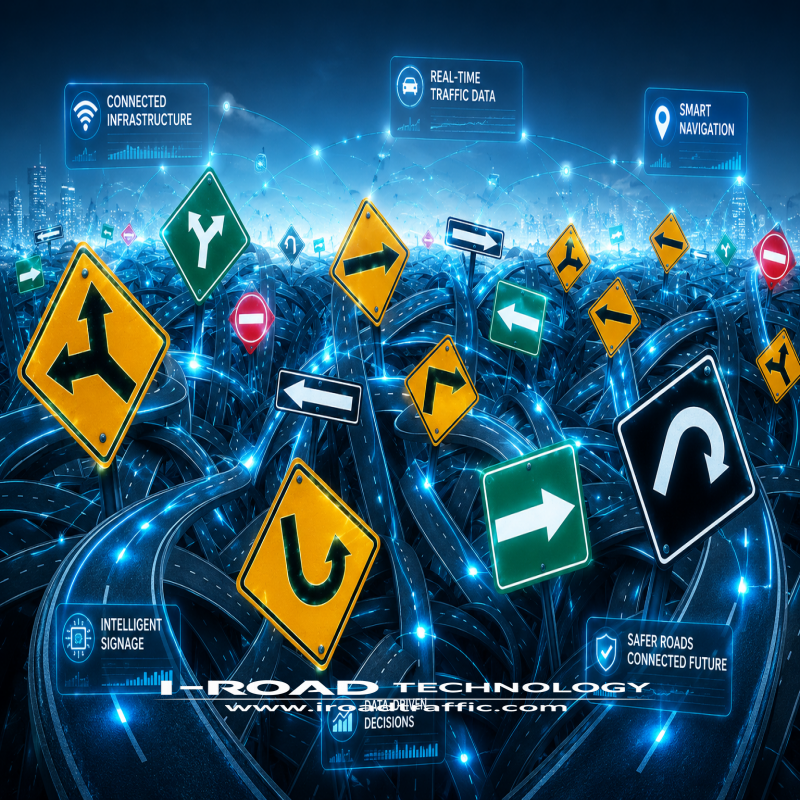
The defining characteristic of intelligent transport is the application of multi-source data: comprehensive, real-time data spanning all elements — people, vehicles, roads, and environment — across all locations and at all times. This data is processed to generate actionable outputs, which are then fed back into the system in near real time, creating a continuous loop of interaction and coordination across every element of the transport network.

There is a compelling case to be made that traffic signs will inevitably become — and indeed are already becoming — critical data connection points within this intelligent transport ecosystem. They may rightly be regarded as the operational core of data application in road transport.

Connecting Roads

Every traffic sign exists because something about the static road environment changes at that location: alignment, sightlines, structural conditions, spatial constraints, or the nature of road use. For a vehicle in motion, any change in the static road environment represents a potential hazard — one that depends on the traffic sign to communicate and warn. Traffic signs are therefore the primary data interface between the physical road and its users.

Connecting Rules

Established traffic laws, technical standards, and the operational directives of traffic management authorities are distilled into concise, universally intelligible graphics and text — what might be called the language of traffic. Traffic signs are the medium through which this regulatory data is encoded and communicated; they are the critical connection between rule systems and the road environment.

Connecting People and Vehicles

As autonomous driving technology matures and deployment scales, the road is no longer shared only by pedestrians, motor vehicles, and cyclists — it is increasingly shared by intelligent agents: the onboard systems of autonomous vehicles that must identify, parse, and act on traffic signs in real time. In this context, the traffic sign becomes a trusted point of verification between the physical world and the digital model — a critical connection between human road users, autonomous systems, and the data layer that underpins both.

Connecting with the Environment

Road and traffic conditions are inherently dynamic. Extreme low-visibility events — heavy rain, dust storms, dense fog, ice and snow — challenge every other sensing modality. The traffic sign, by virtue of its passive optical properties (retroreflectivity) and, increasingly, its active luminous capabilities, continues to deliver information reliably under conditions where cameras and other sensors may fail. This makes it an irreplaceable node in

Connecting an Industrial Ecosystem

The physical ubiquity of traffic signs — present at every meaningful point of change across the entire road network — creates upstream and downstream dependencies that span legislation, policy, planning, design, civil engineering, and materials science. This constitutes what might be called an industrial ecosystem around the traffic sign. A genuine technological innovation in traffic sign design does not stay contained: it propagates through the entire ecosystem, reshaping standards, procurement, and practice at every level.

The Coordination Imperative

The ultimate objective of intelligent and automated road transport — autonomous driving included — is seamless human-machine integration and vehicle-road cooperation. The operative word is cooperation: meaningful collaboration between distinct elements of a system. Without it, proximity means nothing.

Wang Jian, a member of the Chinese Academy of Engineering and formerly Chief Technology Officer at Alibaba Group, captured this precisely when he observed that the greatest distance in the world is the distance between a traffic signal and a surveillance camera — two devices mounted centimetres apart, yet with no direct data exchange between them.

Traditional road transport engineering has always relied on traffic signs as the language through which roads, vehicles, people, and environments communicate.

The emergence of modern communications technology and real-time data processing has elevated the traffic sign from a passive physical medium to an active data connection point — one capable of dramatically improving the efficiency of information exchange across all elements of the transport network, in all places, at all times. Crucially, this is not a theoretical proposition: it is a practical, implementable connection built on the most durable and universally deployed infrastructure asset in road transport.

发表回复

您的邮箱地址不会被公开。 必填项已用 * 标注