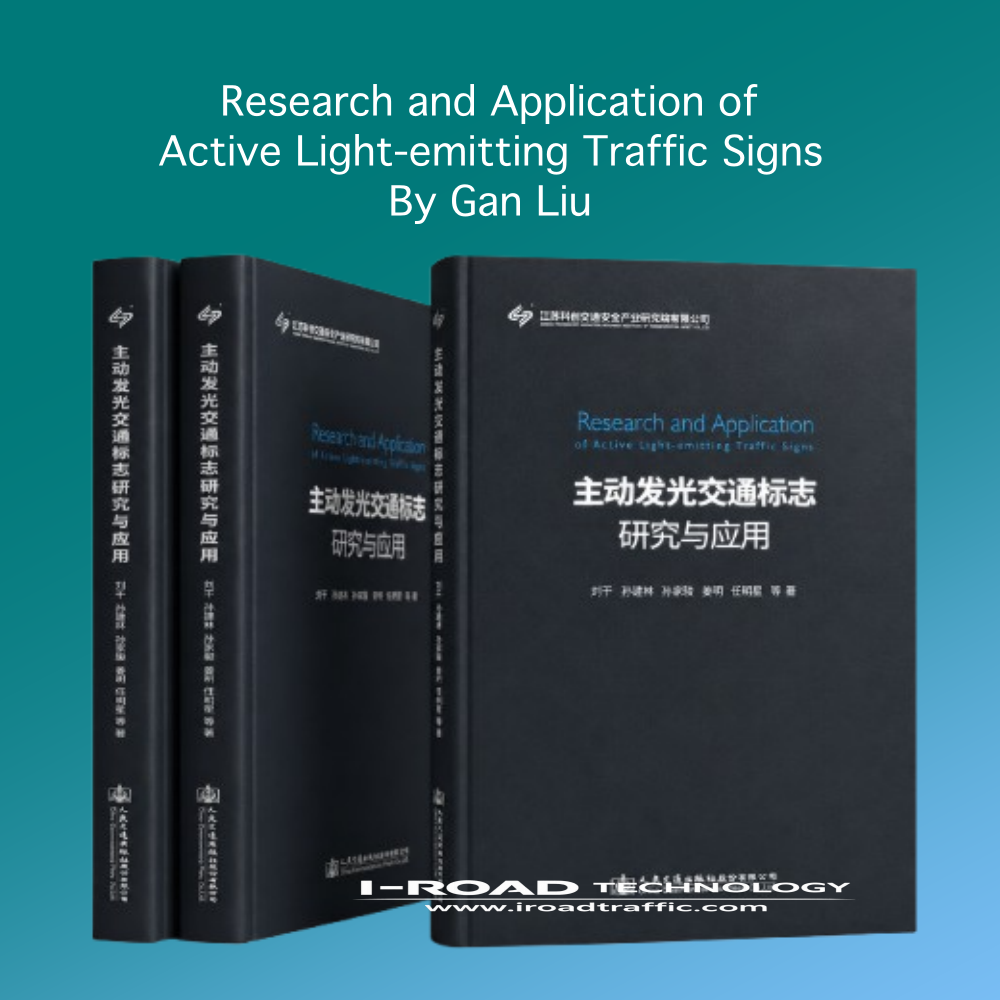
Publications:Collected Works of Research and Application on Active Light-emitting Traffic Signs

About This Book

This volume was principally written and edited by Liu Gan, founder of I-ROAD, and published by China Communications Press (People’s Communications Publishing House, China) in 2019. Building on a survey of international research and practice in traffic signage, and drawing on the realities of road traffic in China, the author conducted a systematic study of active light-emitting traffic signs.

The work covers international field research; studies on the visibility (conspicuity) and cost-effectiveness of active light-emitting signs; a comparative analysis of active light-emitting signs versus retro-reflective (reflective-film) signs; and research into the in-service performance of active light-emitting signs.

The book serves as a working reference for professionals in traffic management and traffic engineering, and also offers teaching reference and extended reading for graduate students in related disciplines at universities and colleges.

An English edition is currently being translated and edited, with worldwide publication anticipated in 2026.

Contents

  1. Active Light Emission: Helping More Lives Benefit from the Upgrading of the Road Traffic Sign Industry
  2. The Role and Significance of Driving Technological Innovation and Upgrading in the Traffic Sign Industry
  3. Proactive Prevention, Intelligent Early Warning, and Traffic Calming: Innovating Information Management Technology for Traffic Signs — International Field Research
  4. Stillness Mastering Motion, Wonder Emerging from Silence: A Field Report on Road Traffic Sign Technology in the United States
  5. Safeguarding Traffic Safety with Advanced Management and Technology: A Field Report on Traffic Signs in South Korea and Japan — Research and Application
  6. Research and Practice on Improving the Visibility of Expressway Guide Signs
  7. Applied Research on Retrofitting the Guide-Sign System of the Nanjing Inner Ring Expressway
  8. A Comparative Analysis of Active Light-Emitting Road Traffic Signs and Retro-Reflective-Film Road Traffic Signs
  9. A Study on the Cost-Effectiveness of LED Active Light-Emitting Traffic Signs
  10. Experimental Research and Analysis on the Visibility of LED Active Light-Emitting Traffic Signs
  11. Research on the Visibility Performance of Active Light-Emitting Panels under Rain and Fog Conditions
  12. Research on the Visibility Performance of LED Active Light-Emitting Signs
  13. Research on the In-Service Performance of LED Active Light-Emitting Traffic Signs
  14. Research on Improving the Visibility of Active Light-Emitting Road Traffic Signs Based on LED Lens Optimization
  15. Research on the Nighttime Visibility of Road Traffic Signs

Appendices

  1. Selected projects supporting the applied research findings of this book
  2. Test report comparing the nighttime visibility of LED active light-emitting signs and retro-reflective signs
  3. Certificate of appraisal of scientific and technological achievements
  4. An explanation of the necessity of installing active light-emitting signs on illuminated highways
  5. Test and evaluation of the use of active light-emitting technology to improve road traffic safety
  6. Technical standards, intellectual property, and quality certifications involved in this book

Author’s Preface

Human understanding is always limited.

Consider how people walk along the road and vehicles travel along it — people, vehicles, and the road all set within the natural environment. Travel seems simple, yet so many travelers have left their lives on the road forever.

Consider a single traffic sign, the thing I have devoted myself to. Again and again I have had to explain to the company’s many different partners why this sign must emit light of its own; why it must not be like a glowing lamp; why it can prevent traffic accidents; why the process of promoting and applying it has been so extraordinarily difficult; and why an opportunity that looks so simple yet so powerful was left to me. There are far too many “whys” for me to account for.

In moments of helplessness, I thought of giving up. In the moments when giving up was not an option, all I could do was learn, seek help, and seek collaborative research.

In the Netherlands, Germany, France, Switzerland, the United States, South Korea, Japan, and Australia — on the roads of countries leading the world in traffic-safety management — I saw, clearly, in those illuminated traffic signs, the needs of travelers and the hopes of researchers. And yet, one professional road-safety research institution after another told me that research into the visibility of traffic signs had come to rest at reflective film. Was some devil controlling people — decreeing that traffic signs need not improve their visibility, need not be recognizable to travelers in all-weather conditions, need not be innovated upon? I found my answer in Article 25 of the Road Traffic Safety Law of the People’s Republic of China: “The installation of traffic signals, traffic signs, and road markings shall comply with the requirements of road traffic safety and smooth flow and with national standards, and shall be kept clear, conspicuous, accurate, and intact.”

In China today, some scholars estimate that the economic loss caused each year by road traffic accidents exceeds one trillion yuan — a harm to society as fierce as a tiger. We should recognize that reducing accidents means reducing risk: using limited funds to do the things that lower risk to the greatest possible degree.

We should also recognize that, in road traffic safety engineering, “signs and markings governing traffic” is the true path — it is proactive prevention. Next comes the use of signal lights to manage the order and safety of large traffic flows; and after that, the use of facilities such as separation and crash barriers to mitigate the harm of accidents.

An active light-emitting traffic sign is not a sign that shines a lamp — the human eye cannot look directly into a glowing lamp. Rather, it displays traffic information to travelers; it is high-definition guidance pointing in the right direction.

It was the research, application, and promotion of active light-emitting traffic signs that brought my entrepreneurial and innovation team and me into the field of road traffic safety research. It led me to publish, in 2016, A New Understanding of Traffic Safety: Reflections of a Traffic Maker; it led us to obtain dozens of intellectual property achievements and two provincial- and ministerial-level Third-Class Awards for Science and Technology; and it gave our business operations and research work an enduring vitality.

As the manuscript of this book is submitted, my wish — “to give traffic signs power, light, and a network connection” — has been realized, and the new concept I have put forward, “intelligent signs and markings governing traffic,” is flourishing and only beginning to show its potential. With the visualization and intelligence of signs and markings, the cause of road traffic safety has gained new hope and reached a new height.

For the publication of this book, I wish to thank the experts who researched and wrote alongside me; to thank all those from every walk of life who have helped SK Traffic Safety; and to thank the friends who support the cause of traffic safety and who cherish the lives of those who travel.

发表回复

您的邮箱地址不会被公开。 必填项已用 * 标注