
How Can Traffic Signs Be Made Visible in Rain and Fog?

Since the birth of retroreflective sheeting in the 1930s, its ability to return vehicle headlight beams toward their source has satisfied motorists’ need to read traffic signs and roadside facilities at night, earning the material widespread adoption.

Yet one drawback cannot be ignored: precisely because retroreflective signs depend on vehicle headlights, they become useless in low-visibility conditions such as rain, fog, and haze—whenever road users have no headlights, or their headlights fail to project light forward—making such conditions a frequent trigger of traffic accidents.

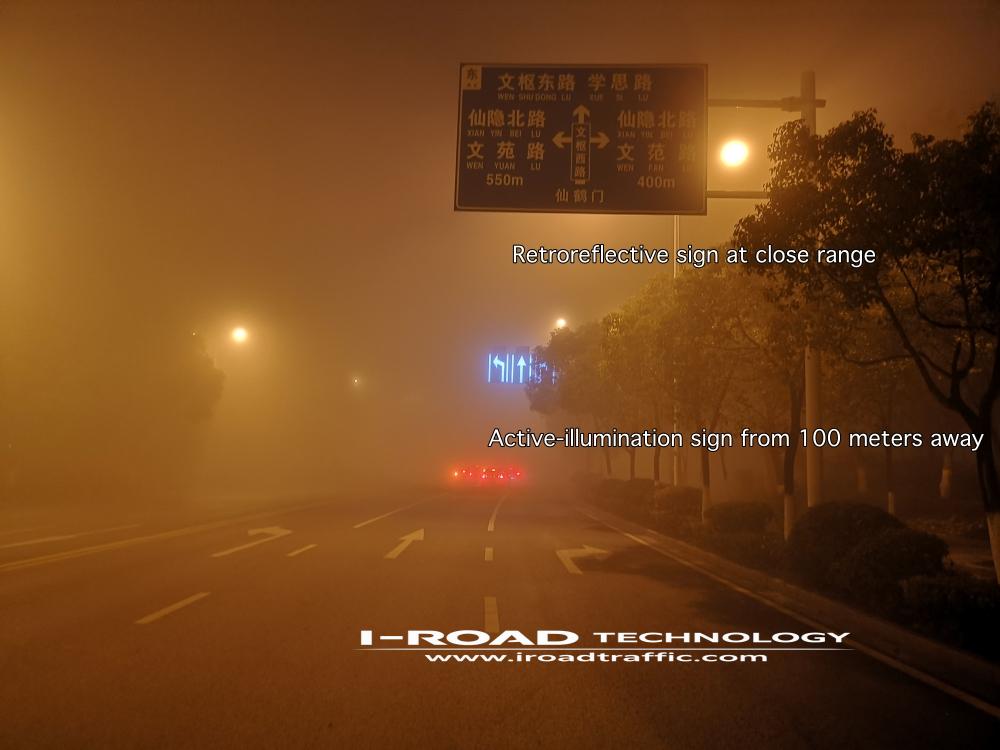
In rainy or foggy weather, the medium suspended in the air is water-vapor particles. When headlight beams strike these particles, they scatter into a diffuse white blur. The light reaching the surface of a retroreflective sign within the visible range becomes far less efficient, or fails to reach the sign at all—so the sign cannot “reflect” and cannot be seen by the driver.

The darker the rainy or foggy night, the greater the safety risk at road intersections, entrances, and exits—and the more urgently drivers need to clearly see the roadside and overhead sign facilities within their visible range.

What, then, can be done?

The common international practice is to install lighting fixtures above or below a traffic sign. But this approach raises the structural demands on the sign’s support poles, increases electricity consumption, and makes maintenance more difficult. Given these extremely high costs, many countries and regions have not adopted such safety measures.

Meanwhile, as the global climate deteriorates year by year, road travel faces ever more low-visibility conditions of rain, fog, and haze. Making traffic signs clearly legible at a distance and around the clock has become a major challenge for road traffic safety worldwide.

In 2018, the China team of the American firm I-ROAD Technology carried out a “sight-distance enhancement” project in Nanjing. Across roughly 10 square kilometers of the Xianlin University Town, the team installed more than 300 sets of partial-face backlit active-illumination signs, mounted above the traffic lanes to indicate lane direction. The technology and the project were successfully validated: there was no need to alter the existing metal support structure of the sign poles; electricity consumption was as low as about 15 W per square meter; the signs offered an ultra-long service life of seven years or more with no maintenance required; they were solar-powered; and they remained clearly legible even in dense fog with visibility between 50 and 200 meters—conditions under which all other retroreflective-sheeting signs in use at the same time and location had already failed. Most crucially, these partial-face backlit active-illumination signs still incorporate retroreflective sheeting: by day, or whenever they operate without power, they remain high-quality retroreflective signs

发表回复

您的邮箱地址不会被公开。 必填项已用 * 标注