About This Book
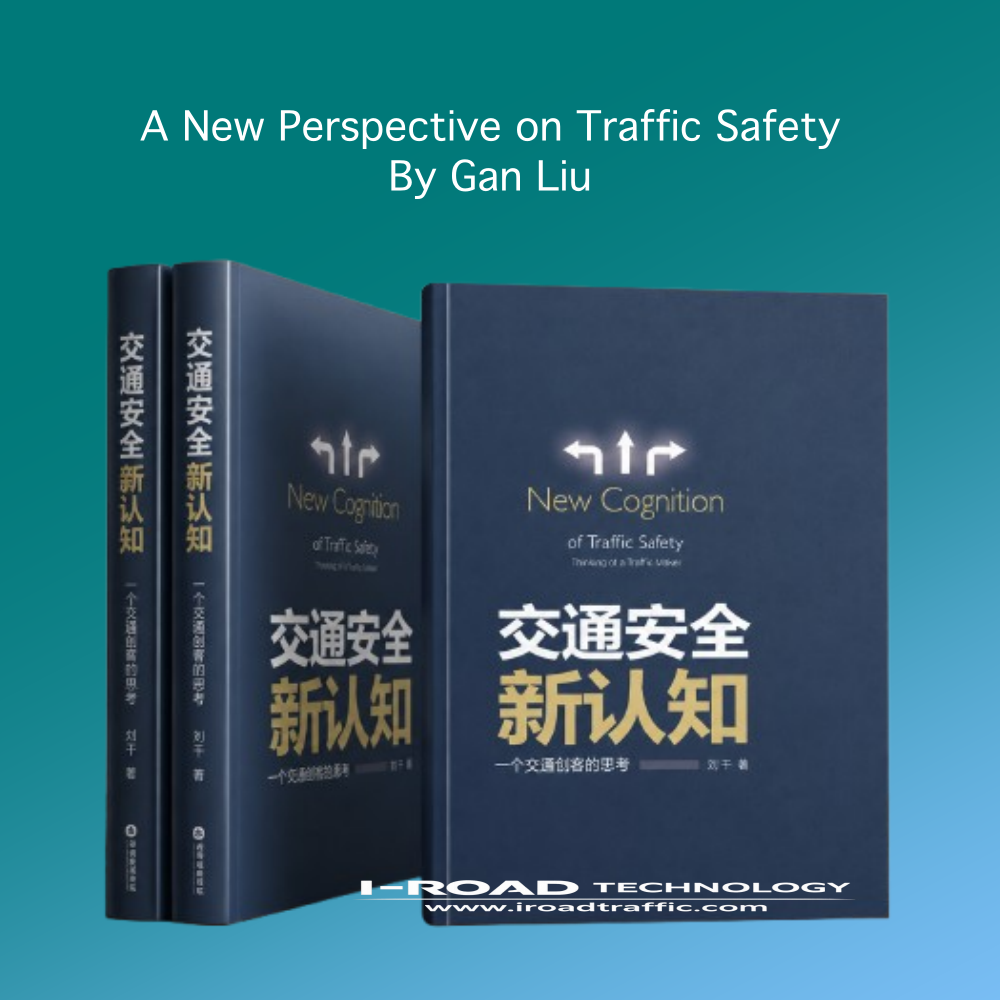
Written by Liu Gan, founder of I-ROAD, this book was published by China Communications Press (People’s Communications Publishing House, China) in 2019. It brings together the author’s theoretical perspectives on traffic safety developed over many years, his analysis and vision for the transportation industry, and his first-hand insights into innovative business operation and management within the field of traffic safety.
The book offers a useful reference for government traffic-management agencies, for transportation professionals at universities and research institutions, and for those studying road traffic engineering and related fields.
Selected Essays
The volume collects more than forty essays, including:
- Reflections of a Traffic Maker
- Road Traffic Safety Calls for a Nationwide Movement in Public Awareness
- Cities Must Take the Hidden Dangers of Road Intersections Seriously
- Designing and Installing Road Traffic Safety Facilities through the Concept of “Street Furniture”
- An Analysis of China’s Road Traffic Safety Facility Products
- How to Unclog a City’s “Arteries”
… and more.
Excerpt
A systematic review of road traffic safety governance reveals that three approaches are commonly employed: governance through people, governance through law, and governance through technology.
Governance through People
Governance through people refers to using various forms of education and public communication so that road users travel carefully of their own accord, thereby improving the effectiveness of road traffic safety governance. These methods are simple and easy to implement, and traffic administrators in virtually every country have relied on them over the long term. As a developing country, China makes especially common use of such methods — most notably the traffic-safety slogans that have blanketed streets and lanes for many years. On the educational front, the country has also carried out many forms of road-safety instruction for drivers and for students in schools.
Governance through Law
Governance through law refers to using legislation to constrain the conduct of road users, employing penalty provisions with deterrent force to achieve effective road traffic safety management. Its prerequisite is the formation of a shared sense of rules, together with a society whose economic development and standard of living have reached a certain level. This approach is widely applied in both developing and developed countries. China implemented its first Road Traffic Safety Law on 1 May 2004; after more than a decade of practice, it has developed a relatively mature system of rule-of-law management thinking.
Governance through Technology
Governance through technology refers to establishing a scientific and systematic set of technical methods to raise the standard of road traffic safety management. It spans many forms and disciplines and is capable of continuously improving every aspect of the road traffic system — the protection of people, the control of roads, the performance of vehicles, and the function of the environment. Consulting, management, planning, design, equipment, facilities, and engineering in the road-transport field are all levers of technological governance. Such governance is often present from the very inception of a road traffic system. For example, paving and hardening a road surface to ease passage is itself a technological method that improves the roadbed and environment to enhance the safety of travel.

